

You’ve done the hard work. Interviews, follow-ups, maybe even a second round. And then the offer comes — and something just doesn’t feel right.
Maybe the salary isn’t there yet. Maybe you accepted another offer. Maybe the timing is off. Whatever the reason, saying “no” to a job offer can feel awkward — even risky. What if you burn a bridge? What if you need this company later?
Here’s the good news: saying no professionally doesn’t have to end the relationship. In fact, done right, it can strengthen it.
This guide walks you through exactly how to decline a job offer gracefully, with real examples, email templates, and tips that keep future opportunities alive.
Why It Matters to Decline a Job Offer the Right Way

Most people think of a job offer as a yes-or-no moment. But in professional circles, how you say no matters just as much as the decision itself.
Recruiters and hiring managers remember candidates who handle rejections with class. Companies rehire. Industries are smaller than you think. The person who interviewed you today could be your client, colleague, or future boss tomorrow.
According to LinkedIn’s hiring data, professionals who maintain respectful relationships during offer declines are significantly more likely to be re-contacted for future roles.
Declining poorly — going silent, giving a vague excuse, or being ungrateful — can quietly close doors you didn’t mean to shut.
When Should You Decline a Job Offer?
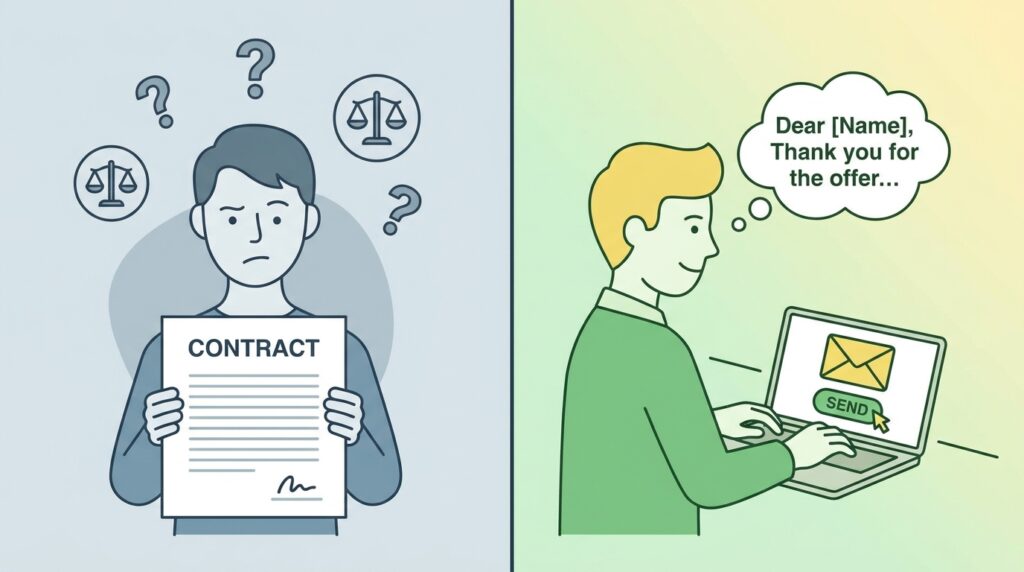
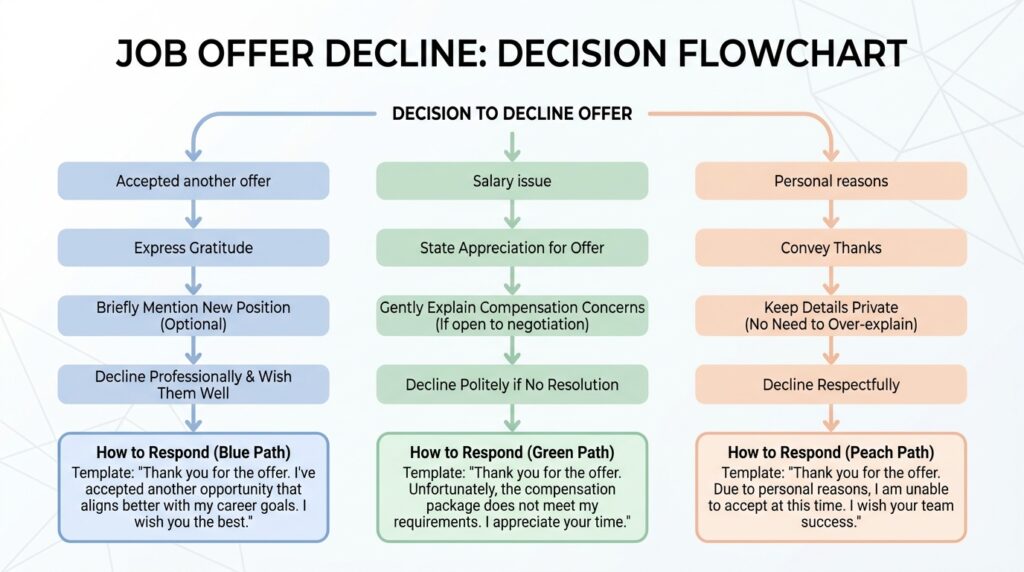
It’s okay to say no to a job offer for many reasons. Here are some of the most common — and all of them are valid:
- Better offer elsewhere — You received a more competitive offer with higher pay or better growth.
- Salary didn’t meet expectations — After negotiation, the compensation still doesn’t work for your life.
- Role wasn’t the right fit — The job description shifted, or the culture didn’t feel like a match.
- Personal circumstances changed — Life happens. A family situation, relocation, or health matter can shift priorities.
- Timing was off — You’re not ready to leave your current role just yet.
- Gut feeling — Sometimes you just know it’s not right, and that’s worth trusting.
None of these require an apology. They do require professional communication.
The Core Principles of Declining Gracefully
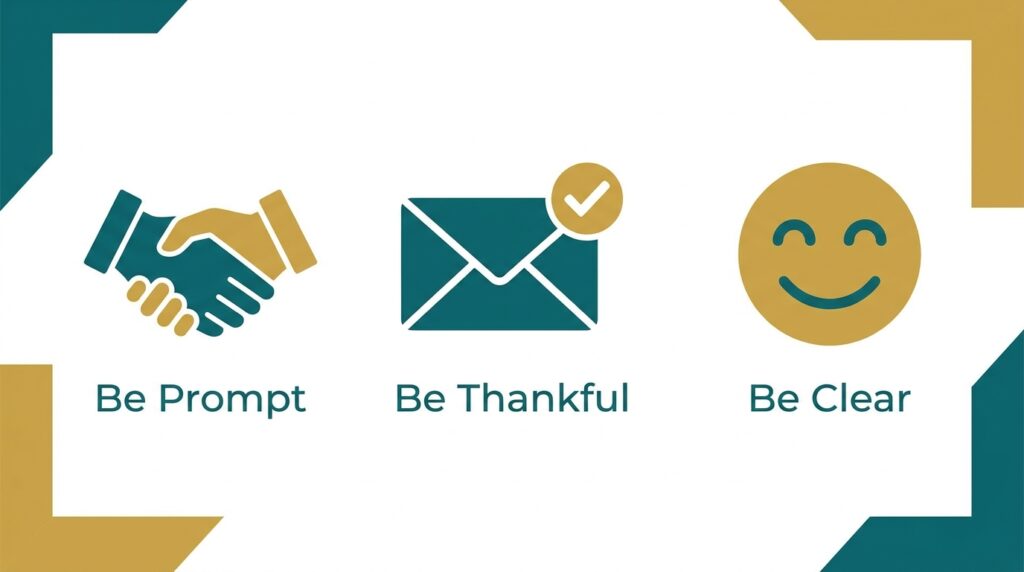
Before you write a single word, understand the three rules that make every professional decline land well.
1. Be Prompt
Don’t wait too long. The company may be holding off other candidates while you decide. Notify them as soon as you’ve made your decision — ideally within 24 to 48 hours. This shows professional respect for their time and keeps their hiring process moving.
2. Be Grateful
Even if the process was frustrating or the offer was way below your expectations, thank them. Express appreciation for their time, the opportunity, and the consideration. This costs you nothing but keeps the relationship warm.
3. Be Clear (Without Oversharing)
You don’t owe a full explanation. A brief, honest reason is enough. You don’t need to detail your competing offer, list their company’s weaknesses, or apologize excessively. Short, kind, and clear is the ideal formula.
How to Turn Down a Job Offer But Keep the Door Open — Step by Step
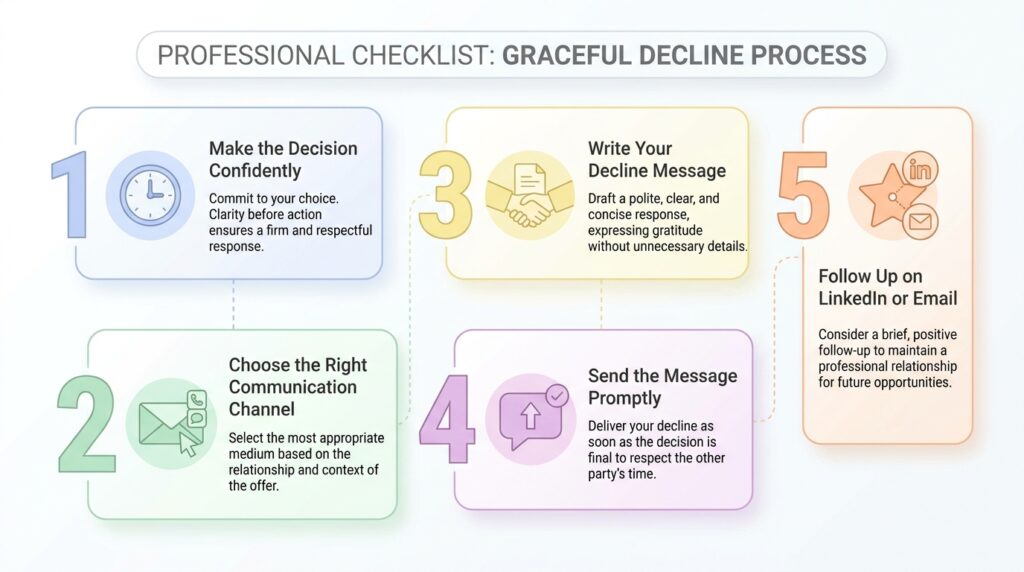
Here’s a simple process you can follow every time.
Step 1 — Make the Decision Confidently
Once you’ve decided to decline, commit to it. Wavering or going back and forth after the fact can come across as unprofessional or indecisive. Trust your reasoning and move forward with confidence.
Step 2 — Choose the Right Communication Channel
A phone call followed by a written email is the gold standard. The call is personal and shows respect. The email creates a written record and gives the hiring manager something to reference.
If the process was handled entirely via email, an email-only response is perfectly acceptable. Just make sure it’s thoughtful — not a one-liner.
Step 3 — Write Your Decline Message
This is where most people freeze. Below is a formula that works every time:
- Open with gratitude — Thank them for the offer and the process.
- State your decision clearly — Don’t bury the lead. Be direct.
- Give a brief reason (optional) — One sentence is enough.
- Express genuine interest in staying connected — This is the “door open” part.
- Close warmly — Wish them success and leave on a positive note.
Step 4 — Send the Message Promptly
Don’t sit on a perfectly written email for three days. Send it as soon as it’s ready. The longer you wait, the more it feels like an afterthought.
Step 5 — Follow Up on LinkedIn or Email (Optional but Powerful)
A week or two after declining, connect with the hiring manager or recruiter on LinkedIn. A short note like “Loved learning about your team — hope we can stay in touch” does more than any apology ever could.
Word-for-Word Email Templates to Decline a Job Offer
Template 1 — Accepted Another Offer
Subject: Re: [Job Title] Offer — [Your Name]
Dear [Hiring Manager’s Name],
Thank you so much for offering me the [Job Title] position at [Company Name]. I genuinely enjoyed learning more about your team and the work you’re doing.
After careful consideration, I’ve decided to accept a different opportunity that aligns more closely with my current career goals.
I have a lot of respect for your organization and the people I had the chance to speak with. I hope our paths cross again in the future, and I’d love to stay connected.
Thank you again for your time and consideration.
Warm regards, [Your Name]
Template 2 — Compensation Didn’t Work Out
Subject: Re: [Job Title] Offer
Dear [Hiring Manager’s Name],
I sincerely appreciate the offer for the [Job Title] role and the time your team invested in the interview process. It was a pleasure speaking with everyone.
After much thought, I’ve decided to respectfully decline. The compensation package, despite your flexibility, doesn’t align with my current needs.
I genuinely admire what your team is building, and I hope to have the opportunity to work together down the line. Please keep me in mind for future roles that may be a better fit.
Thank you again, and I wish you and the team continued success.
Best, [Your Name]
Template 3 — Personal Reasons / Timing
Subject: Job Offer — [Your Name]
Dear [Hiring Manager’s Name],
Thank you so much for the offer to join [Company Name] as [Job Title]. I’m truly grateful for the time and care your team put into this process.
Due to personal circumstances, I’m unable to accept this offer at this time. It was a difficult decision, as I have a great deal of respect for your company and what you’ve built.
I would love to stay in touch and hope there might be an opportunity to work together in the future.
Thank you again for everything.
Sincerely, [Your Name]
What NOT to Say When Declining a Job Offer
Even with the best intentions, a few common mistakes can leave a bad impression.
| Avoid This | Say This Instead |
|---|---|
| Going completely silent (ghosting) | Send a timely, brief email |
| “Your offer was way too low” | “The compensation didn’t meet my current needs” |
| Giving a vague non-answer | Be clear: “I’ve decided to decline” |
| Over-explaining or apologizing excessively | Keep it brief and gracious |
| Burning bridges by criticizing the company | Stay positive and professional |
| Waiting weeks to respond | Respond within 24–48 hours |
Ghosting a recruiter is increasingly common — and increasingly damaging to your professional reputation. Even a two-line email beats silence every time.
How to Keep the Door Open After Declining
The real skill isn’t just how you say no — it’s how you stay connected afterward.
Connect on LinkedIn Right Away
After sending your decline, search for the hiring manager or recruiter on LinkedIn and send a connection request with a short personalized note. Something like: “It was great connecting during the interview process — I’d love to stay in touch.”
Stay Engaged With the Company
Follow their company page. Engage with their posts occasionally. Share relevant content. This keeps you on their radar without being pushy — and it shows genuine interest.
Check Back In After 6–12 Months
Things change — your situation, their needs, the role itself. A short check-in email after some time has passed can restart a conversation naturally. Reference the original process and express renewed interest if it’s genuine.
Ask About Future Opportunities Directly
In your decline email itself, you can plant a seed:
“If a role comes up that might be a better fit in the future, I’d love to hear about it.”
This is direct, non-presumptuous, and genuinely appreciated by most recruiters.
Special Situations — What to Do When It’s Complicated
Declining After Verbally Accepting
This is a stressful situation, but it happens. The key is to act fast and be honest without being overly apologetic.
It is legal to decline an offer even after a verbal acceptance, since employment contracts are typically formalized in writing. However, the ethical and professional thing is to notify the company immediately, explain briefly, and apologize for any inconvenience caused.
Declining a Counteroffer From Your Current Employer
If your current employer makes a counteroffer after learning you were job searching, and you decide to stay, you’ll need to decline the new company’s offer. Use Template 1 (accepted another opportunity) and keep your reason vague to avoid mentioning your current employer by name.
Declining When You Might Want the Job Later
If there’s any chance you’ll want to work there in the future, your decline email should do double duty: close the current offer gracefully while explicitly expressing long-term interest. This is your best opportunity to plant that seed.
Expert Tips for Declining a Job Offer Like a Pro
Here are insights that go beyond the basics:
1. Always close the door softly, not firmly. Your decline email should never feel like a permanent goodbye. Language like “I hope our paths cross again” or “please keep me in mind” signals openness without being presumptuous.
2. Personalize every message. Generic emails are noticed. Reference a specific conversation, a project you discussed, or something you genuinely admired. It shows you paid attention — and that you mean what you say.
3. Don’t wait for the “perfect” email. A good email sent promptly beats a perfect email sent late. Once you’ve written something clear, kind, and professional, send it.
4. Notify verbally when possible. If you have a strong relationship with the recruiter or hiring manager, a quick phone call before the email shows extra respect. It’s uncommon enough that it genuinely stands out.
5. Keep your professional network clean. Research from SHRM consistently shows that candidate experience — even in rejections — directly shapes employer brand perception. Companies that treat candidates well expect the same in return. Bring your best professional self even when saying no.
How to Turn Down a Job Offer But Keep the Door Open
Is it okay to decline a job offer after accepting verbally?
Yes, it’s generally acceptable to decline even after a verbal acceptance. A verbal agreement isn’t typically a legally binding contract. That said, you should notify the employer immediately, be honest, and apologize briefly for any disruption. Acting quickly minimizes the impact.
How do you decline a job offer without burning bridges?
Keep your message positive, prompt, and brief. Express genuine gratitude, offer a clear but non-damaging reason, and explicitly express interest in staying in touch. Avoid criticism of the company, role, or the hiring process.
Should I tell the new employer why I’m declining?
You don’t have to. A brief, honest reason is professional — but you’re not obligated to explain in detail. Common reasons like “accepting another opportunity” or “the compensation didn’t align” are both honest and professional without oversharing.
How long do I have to decline a job offer?
Most offers come with a decision window of a few days to one or two weeks. Once you’ve made your decision, respond as soon as possible — ideally within 24 to 48 hours. Delaying your response holds up their hiring process and reflects poorly on your professionalism.
Can you reapply to a company after declining their offer?
Yes, in many cases. Especially if you declined gracefully and stayed in touch, many companies are open to future applications. Some recruiters even reach back out months later. The key is that you left a positive impression the first time.
Quick Reference — Decline a Job Offer Checklist
Before you hit send, run through this:
- Have I made my decision confidently?
- Am I responding within 24–48 hours?
- Does my message express genuine gratitude?
- Have I stated my decision clearly (not vaguely)?
- Is my reason brief and non-damaging?
- Have I expressed interest in staying connected?
- Does my email sound human, not robotic?
- Have I proofread for tone and typos?
Conclusion: Say No Gracefully, Keep the Future Open
Turning down a job offer isn’t a failure — it’s a professional decision that, handled right, can actually build your reputation.
The people who handle rejections with grace are remembered. They get called first when new roles open. They become the candidates that hiring managers recommend to colleagues. They move through the professional world with fewer burned bridges and more open doors.
So the next time you need to say no, take a breath, write a thoughtful message, and remember: how you say no today shapes who calls you tomorrow.
Use the templates in this guide, follow the steps, and give every declined offer the same professionalism you’d give an accepted one. Your future self will thank you.