
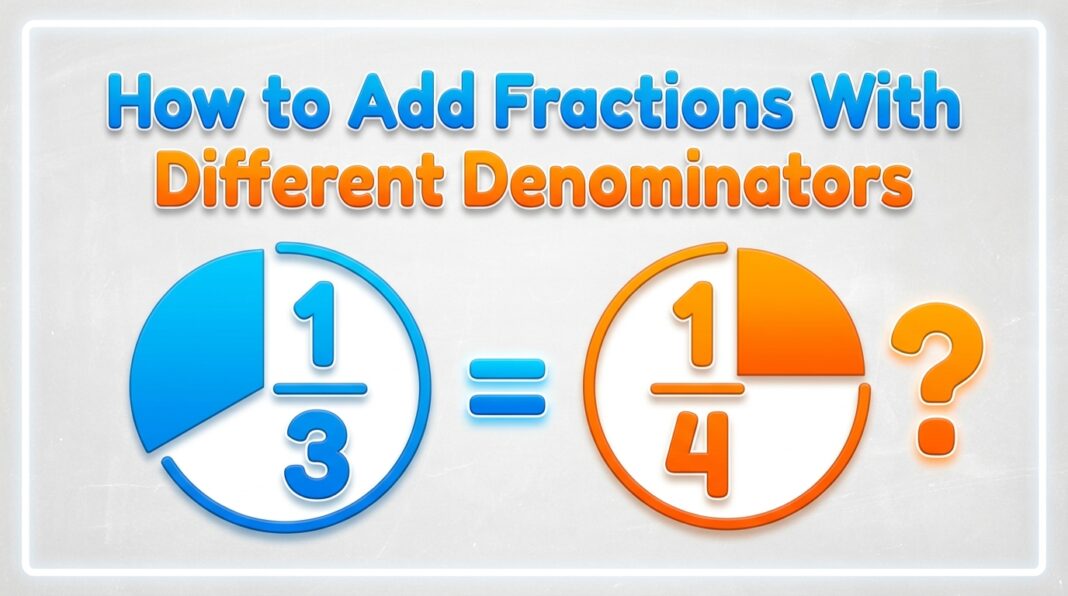

You are staring at a math problem that looks something like this: 1/3 + 1/4. The numbers are simple, yet something about those different bottom numbers makes your brain pause.
You are not alone. Adding fractions with different denominators trips up millions of students, parents helping with homework, and even adults who just need a quick refresher. The bottom number — called the denominator — changes everything about how fractions work together.
The good news? Once you understand the logic behind it, the process becomes almost automatic. This guide breaks down every step clearly, walks you through real examples, and gives you tools to solve these problems with confidence.
Whether you are in middle school, helping your child with homework, or brushing up your math skills as an adult, this is the only guide you need.
What Are Fractions and Why Do Denominators Matter?
Before diving into the steps, it helps to understand what you are actually working with.
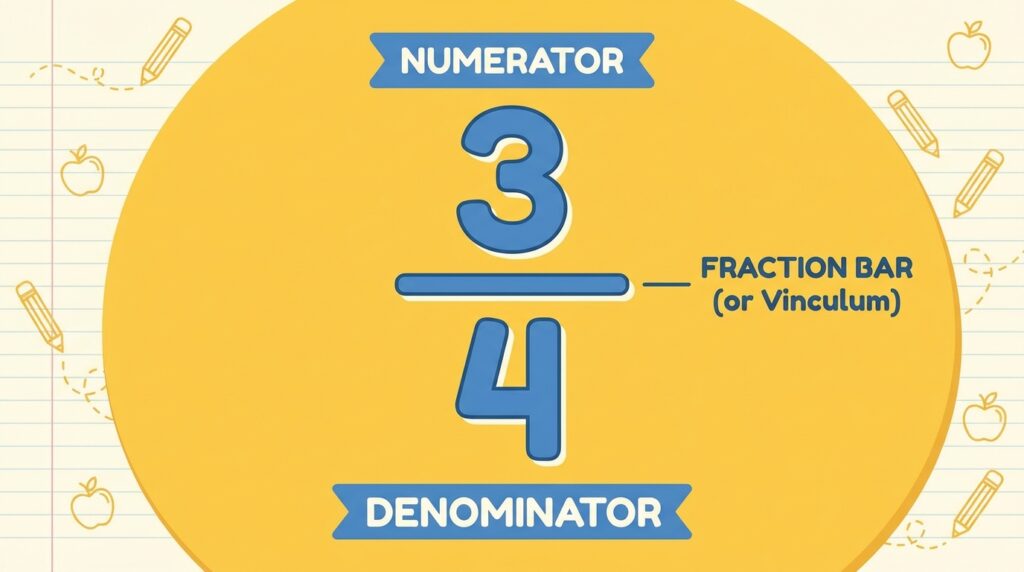
A fraction represents a part of a whole. It has two parts:
- Numerator — the top number, showing how many parts you have
- Denominator — the bottom number, showing how many total equal parts the whole is divided into
When two fractions share the same denominator (called like fractions), adding them is simple. You just add the numerators.
But when the denominators are different, you cannot simply add straight across. Why? Because the fractions are measuring pieces of different sizes, and you cannot add pieces that are not the same size without converting them first.
Think of it this way. If someone ate 1 slice out of a pizza cut into 3 pieces, and another person ate 1 slice out of a pizza cut into 4 pieces, those slices are not the same size. You cannot just say they ate “2 slices” equally. You have to account for the size difference.
That is exactly what finding a common denominator solves.
The 4-Step Method to Add Fractions With Different Denominators
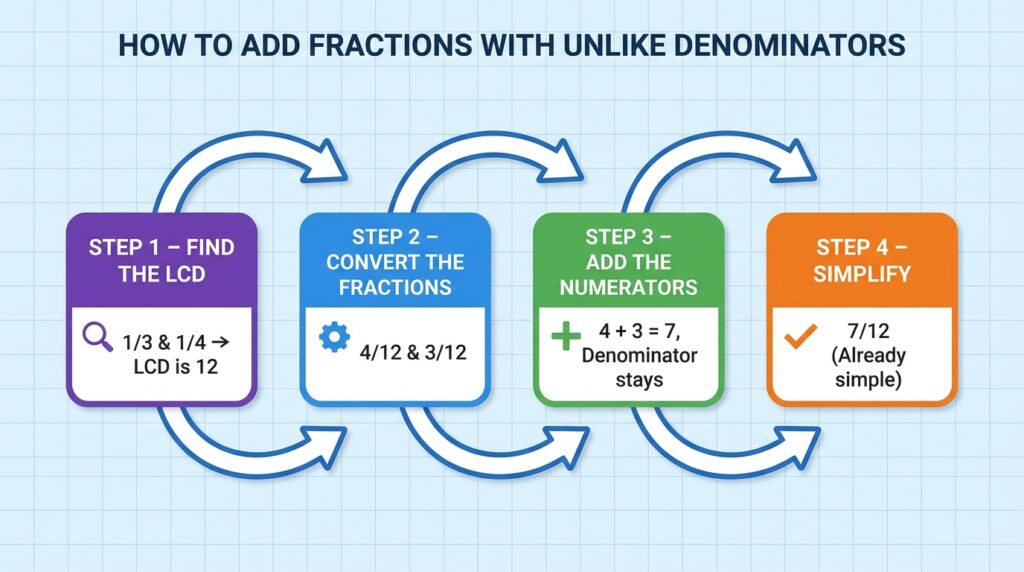
Here is the complete process laid out cleanly. Follow these four steps every time, and you will get the right answer.
Step 1: Find the Least Common Denominator (LCD)
The Least Common Denominator (LCD) is the smallest number that both denominators divide into evenly.
For the problem 1/3 + 1/4, the denominators are 3 and 4.
Ask: What is the smallest number that both 3 and 4 go into?
- Multiples of 3: 3, 6, 9, 12, 15…
- Multiples of 4: 4, 8, 12, 16…
The LCD is 12.
Step 2: Convert Each Fraction to an Equivalent Fraction
Now you need to rewrite each fraction so both have the LCD (12) as the denominator.
For 1/3:
- Ask: What do I multiply 3 by to get 12? Answer: 4
- Multiply both the numerator and denominator by 4
- 1/3 becomes 4/12
For 1/4:
- Ask: What do I multiply 4 by to get 12? Answer: 3
- Multiply both the numerator and denominator by 3
- 1/4 becomes 3/12
This is called creating equivalent fractions — fractions that look different but represent the same value.
Step 3: Add the Numerators
Now that both fractions have the same denominator, you simply add the numerators and keep the denominator the same.
4/12 + 3/12 = 7/12
The denominator stays as 12. You do not add the denominators together.
Step 4: Simplify the Result (If Needed)
After adding, check if your answer can be simplified or reduced. To do this, find the Greatest Common Factor (GCF) of the numerator and denominator, then divide both by it.
For 7/12:
- Factors of 7: 1, 7
- Factors of 12: 1, 2, 3, 4, 6, 12
- The only common factor is 1
Since the GCF is 1, 7/12 is already in its simplest form.
Final answer: 1/3 + 1/4 = 7/12
How to Find the Least Common Denominator: Two Reliable Methods
Finding the LCD is often the trickiest part for beginners. Here are two methods that always work.
Method 1: List the Multiples
Write out multiples of each denominator until you find the first number they share.
Example: 1/6 + 1/8
- Multiples of 6: 6, 12, 18, 24, 30…
- Multiples of 8: 8, 16, 24, 32…
LCD = 24
This method is the most beginner-friendly and works perfectly for smaller numbers.
Method 2: Prime Factorization
For larger numbers, prime factorization is more efficient.
Example: 1/12 + 1/18
Break each denominator into its prime factors:
- 12 = 2 × 2 × 3
- 18 = 2 × 3 × 3
Take the highest power of each prime:
- Highest power of 2: 2² = 4
- Highest power of 3: 3² = 9
LCD = 4 × 9 = 36
This method is ideal once you feel comfortable with factors and prime numbers.
Worked Examples: Practice Problems With Full Solutions
The best way to cement this skill is to see it applied across several different problems. Work through each one carefully.
Example 1: 2/5 + 1/3
Step 1: Find the LCD
- Multiples of 5: 5, 10, 15, 20…
- Multiples of 3: 3, 6, 9, 12, 15…
- LCD = 15
Step 2: Convert the Fractions
- 2/5 → multiply top and bottom by 3 → 6/15
- 1/3 → multiply top and bottom by 5 → 5/15
Step 3: Add
- 6/15 + 5/15 = 11/15
Step 4: Simplify
- GCF of 11 and 15 is 1
- Already simplified
Answer: 11/15
Example 2: 3/4 + 2/6
Step 1: Find the LCD
- Multiples of 4: 4, 8, 12, 16…
- Multiples of 6: 6, 12, 18…
- LCD = 12
Step 2: Convert the Fractions
- 3/4 → multiply top and bottom by 3 → 9/12
- 2/6 → multiply top and bottom by 2 → 4/12
Step 3: Add
- 9/12 + 4/12 = 13/12
Step 4: Simplify and Convert
- 13/12 is an improper fraction (numerator is bigger than denominator)
- Convert to a mixed number: 13 ÷ 12 = 1 remainder 1
- Answer: 1 and 1/12
Example 3: 5/8 + 1/6
Step 1: Find the LCD
- Multiples of 8: 8, 16, 24, 32…
- Multiples of 6: 6, 12, 18, 24…
- LCD = 24
Step 2: Convert the Fractions
- 5/8 → multiply top and bottom by 3 → 15/24
- 1/6 → multiply top and bottom by 4 → 4/24
Step 3: Add
- 15/24 + 4/24 = 19/24
Step 4: Simplify
- GCF of 19 and 24 is 1
- Already simplified
Answer: 19/24
Adding Three or More Fractions With Different Denominators
Once you master two fractions, adding three or more follows the exact same logic — you just find one LCD that works for all denominators.
Example: 1/2 + 1/3 + 1/4
Step 1: Find the LCD for all three denominators
- Multiples of 2: 2, 4, 6, 8, 10, 12…
- Multiples of 3: 3, 6, 9, 12…
- Multiples of 4: 4, 8, 12…
- LCD = 12
Step 2: Convert all three fractions
- 1/2 → 6/12
- 1/3 → 4/12
- 1/4 → 3/12
Step 3: Add all numerators
- 6/12 + 4/12 + 3/12 = 13/12
Step 4: Convert to mixed number
- 13 ÷ 12 = 1 remainder 1
- Answer: 1 and 1/12
The key takeaway: always find one common denominator that all fractions can share before adding anything.
Adding Mixed Numbers With Different Denominators
Mixed numbers (like 2 and 1/3) involve a whole number and a fraction together. Adding them with unlike denominators takes one extra stage.
Example: 2 and 1/3 + 1 and 1/4
Step 1: Separate the whole numbers and the fractions
- Whole numbers: 2 + 1 = 3
- Fractions: 1/3 + 1/4
Step 2: Add the fractions (using the same method)
- LCD of 3 and 4 = 12
- 1/3 = 4/12
- 1/4 = 3/12
- 4/12 + 3/12 = 7/12
Step 3: Combine
- 3 + 7/12 = 3 and 7/12
Answer: 3 and 7/12
If the fractions add up to an improper fraction, convert it and add that whole number part to the whole number total.
Common Mistakes and How to Avoid Them
Knowing the right method is only half the battle. These are the errors that show up most often, and how to dodge them.
Mistake 1: Adding the Denominators Directly
Wrong: 1/3 + 1/4 = 2/7
This is the most common mistake. You never add the denominators. The denominator must stay the same once you have found the common one.
Mistake 2: Only Changing the Denominator, Not the Numerator
When converting to an equivalent fraction, whatever you multiply the denominator by, you must multiply the numerator by the same number.
Wrong conversion: 1/3 → 1/12 Correct conversion: 1/3 → 4/12 (multiply both by 4)
Mistake 3: Forgetting to Simplify
Always check if your final answer can be reduced. If the numerator and denominator share a common factor other than 1, simplify it.
For example, 6/12 should be simplified to 1/2.
Mistake 4: Using a Common Denominator That Is Not the Least
You can use any common denominator, not just the LCD, and still get the right answer. However, using a larger common denominator means you will have bigger numbers to work with and more simplifying to do at the end. The LCD keeps things neat and efficient.
Mistake 5: Forgetting to Convert Mixed Numbers
When adding mixed numbers, students sometimes forget to convert the fraction parts or only work with the whole numbers. Always handle both parts of a mixed number.
A Quick Reference Table
Here is a handy reference for the most common LCD combinations you will encounter:
| Denominators | LCD |
|---|---|
| 2 and 3 | 6 |
| 2 and 4 | 4 |
| 2 and 5 | 10 |
| 3 and 4 | 12 |
| 3 and 6 | 6 |
| 4 and 5 | 20 |
| 4 and 6 | 12 |
| 5 and 6 | 30 |
| 6 and 8 | 24 |
| 8 and 12 | 24 |
Keep this table nearby when you are first learning. Over time, you will memorize the most common LCDs automatically.
Why Learning This Skill Actually Matters
You might wonder when you will ever need to add fractions in real life. The answer: more often than you might expect.
Cooking and baking — recipes regularly require you to combine fractional amounts. Need 1/3 cup of oil and 1/4 cup of water? You are adding fractions.
Home improvement — measuring wood, tiles, fabric, or any material often involves fractions of inches or feet. Contractors and DIY builders use this constantly.
Time management — if one task takes 2/5 of an hour and another takes 1/3 of an hour, knowing the total time means adding those fractions.
Financial math — dividing costs, splitting bills, and working with interest rates all involve fractional thinking.
Understanding fractions is one of the most practical foundational math skills you can develop, because it feeds directly into algebra, geometry, and everyday problem-solving.
Expert Tips to Master Fraction Addition Faster
These tips come from how students who become fluent at fractions actually think about the process:
Tip 1: Always write the problem out vertically. Stacking fractions on top of each other makes it easier to align and compare the denominators.
Tip 2: Double-check your equivalent fractions before adding. Multiply both parts of the fraction — top and bottom — and verify the result before moving forward.
Tip 3: Memorize key LCDs. The pairs 3 and 4 (LCD: 12), 4 and 6 (LCD: 12), and 6 and 8 (LCD: 24) come up constantly. Memorizing them saves time.
Tip 4: Use a number line for visual learners. Drawing fractions on a number line can make the abstract feel concrete. Mark where each fraction falls, then count the total.
Tip 5: Practice with real objects before paper. Cut an apple into 3 equal pieces and take 1 piece. Then cut another apple into 4 equal pieces and take 1. Try to estimate the combined portion visually before solving on paper. This builds intuition.
Tip 6: Verify your answer using decimals. Convert each fraction to a decimal and add them. Then convert your fraction answer to a decimal. They should match.
For example: 1/3 ≈ 0.333, 1/4 = 0.25. Together: ≈ 0.583. And 7/12 ≈ 0.583. Verified.
How to Help Kids Learn This Concept
If you are a parent or teacher supporting a child through this concept, these strategies work especially well for younger learners:
Use food. Pizza, pie, and chocolate bars are natural teaching tools. Physically cut things into different numbers of pieces and show that combining unequal slices requires “fair sizing” first.
Use fraction tiles or strips. Physical manipulatives make the concept of equal-sized pieces tangible. You can find printable fraction strips easily online.
Avoid rushing to the algorithm. Let kids explore why the denominators need to match before drilling the steps. Understanding builds retention.
Connect to language. If a child speaks Spanish or another language, “denominator” comes from “denominar” — to name. The denominator names the kind of fraction you have (thirds, fourths, etc.). You cannot add “thirds” and “fourths” until they are both the same type.
Celebrate small wins. Each correctly solved problem is progress. Fractions frustrate many children and adults alike. Encouragement matters.
Fractions With Different Denominators: Subtraction Connection
Once you understand how to add fractions with unlike denominators, subtraction becomes almost identical — the only difference is the final operation.
Example: 3/4 − 1/3
- LCD of 4 and 3 = 12
- 3/4 = 9/12
- 1/3 = 4/12
- 9/12 − 4/12 = 5/12
The steps are exactly the same through finding the LCD and converting. The only change is you subtract the numerators instead of adding them.
This means learning how to subtract fractions with different denominators comes naturally once you have this addition skill locked in.
Checking Your Work: Two Fast Methods
Making a small error somewhere in the conversion process is easy. These two methods help you catch mistakes quickly.
Method 1: Decimal Conversion
Convert every fraction to a decimal and verify the sum.
- 1/3 = 0.3333
- 1/4 = 0.25
- Sum = 0.5833
- 7/12 = 0.5833
They match. The answer is correct.
Method 2: Cross-Multiply to Verify Equivalence
After converting fractions, cross-multiply to confirm they are truly equivalent.
For 1/3 and 4/12:
- 1 × 12 = 12
- 3 × 4 = 12
- Both sides equal 12, confirming they are equivalent.
These two quick checks take under a minute and give you confidence before moving on.
Practice Problems to Test Yourself
Try solving these on your own before looking at the answers below:
- 1/2 + 1/5 = ?
- 2/3 + 1/6 = ?
- 3/8 + 1/4 = ?
- 5/6 + 1/4 = ?
- 1/2 + 2/7 = ?
- 4/9 + 1/3 = ?
Answers:
| Problem | LCD | Converted | Answer |
|---|---|---|---|
| 1/2 + 1/5 | 10 | 5/10 + 2/10 | 7/10 |
| 2/3 + 1/6 | 6 | 4/6 + 1/6 | 5/6 |
| 3/8 + 1/4 | 8 | 3/8 + 2/8 | 5/8 |
| 5/6 + 1/4 | 12 | 10/12 + 3/12 | 13/12 = 1 and 1/12 |
| 1/2 + 2/7 | 14 | 7/14 + 4/14 | 11/14 |
| 4/9 + 1/3 | 9 | 4/9 + 3/9 | 7/9 |
FAQs About Adding Fractions With Different Denominators
What is the easiest way to add fractions with different denominators?
The easiest way is the four-step method: find the LCD, convert both fractions to equivalent fractions with that LCD, add the numerators, and simplify if needed. For small numbers, listing multiples is the quickest path to finding the LCD.
Can I add fractions without finding the LCD?
Yes. You can use any common multiple, not just the least one. For example, for 1/3 + 1/4, you could use 24 as the common denominator instead of 12. You would get 8/24 + 6/24 = 14/24, which simplifies to 7/12 — the same final answer. The LCD just keeps the numbers smaller and easier to work with.
What is the difference between LCD and LCM?
The Least Common Multiple (LCM) is a concept used in general math. When applied to fractions, the LCM of the denominators becomes the LCD. They are the same calculation — just different names depending on context.
How do I add fractions with large denominators like 18 and 24?
Use prime factorization for efficiency.
- 18 = 2 × 3 × 3
- 24 = 2 × 2 × 2 × 3
- Take the highest powers: 2³ × 3² = 8 × 9 = 72
- LCD = 72
Then convert and proceed normally.
What if my answer is an improper fraction?
An improper fraction (where the numerator is larger than the denominator) is mathematically correct, but it is often better to convert it to a mixed number for clarity. Divide the numerator by the denominator. The quotient is the whole number, and the remainder becomes the new numerator over the original denominator.
For example: 13/4 = 3 remainder 1 = 3 and 1/4.
Conclusion
Adding fractions with different denominators is one of those math skills that feels intimidating until the moment it clicks — and then it feels obvious.
The key insight is this: you cannot add fractions until they speak the same language. That language is the common denominator. Once you convert them, everything falls into place naturally.
To recap the four essential steps:
- Find the LCD — the smallest shared multiple of both denominators
- Convert — rewrite each fraction as an equivalent fraction using the LCD
- Add — combine the numerators, keep the denominator
- Simplify — reduce the answer to its simplest form
Practice the worked examples in this guide until the steps feel automatic. Use the practice problems to test yourself. Refer back to the reference table for common LCDs.
The more you practice, the faster this becomes. And once this skill is solid, you are ready to move into more advanced fraction operations, algebraic fractions, and even early calculus with confidence.
Want to keep building your fraction skills? Work through problems on adding mixed numbers, subtracting fractions, and multiplying fractions next. Each concept builds directly on what you have learned here.